
An American friend told me he thought AI was being put into all sorts of crap. I knew what he meant. Keyboards, fridges, software updates: suddenly everything seems to need an AI feature. I keep looking for the part of the announcement that explains why I would want it.
In January 2024, Microsoft announced a dedicated Copilot key for Windows PCs. The assistant now had its own button on the keyboard. By December 2025, Samsung was announcing refrigerator features built with Google Gemini for CES 2026, including food recognition. Keeping track of what was in the fridge had become another job for AI.
Both features might be useful. But I want to know how they change the ordinary business of using the thing. Does the fridge save me from checking its contents before I go shopping? Does the extra key put something I use within easier reach? That is the explanation I am looking for when a company tells me its product now has AI.
In the companion article, Rogue AI: The danger living in your smart TV, I followed a warning about AI cloning itself onto household devices back to the experiments behind it. This time I am looking at the sales pitch. Why does adding AI seem to have become a requirement before anyone has explained what it improves?
The dishwasher example helped me put the complaint more clearly. Adjusting a wash cycle to how dirty the water is makes sense. A machine that can do that well could save time, water, or electricity. There is no reason to dismiss it just because the box says AI.
Bosch's AquaSensor documentation describes an optical sensor that measures how clean the rinse water is. In automatic cycles, the dishwasher can adjust temperature and runtime to the level of soiling. I can understand what that does without imagining a chatbot thinking about my plates.
Samsung's April 2026 dishwasher announcement describes AI Wash as a turbidity sensor combined with a machine-learning algorithm. Turbidity is the cloudiness of the water. The system uses what it measures to adjust washing and rinsing times. A trained model could be useful there. This is specialised sensing and control, and it does not require general intelligence.
I also need to be clear about what I am criticising. A large language model generates language. Image recognition and a system that adjusts a wash cycle do different jobs. A product can combine them, but calling all of it “AI” hides the details needed to judge whether it makes sense.
For the dishwasher, show me cleaner dishes, less water, lower energy use, or fewer failed washes under comparable conditions. Compare the trained model with a well-designed conventional controller. If it does the job better, that is a good reason to use it. The sticker on the door leaves that question unanswered.
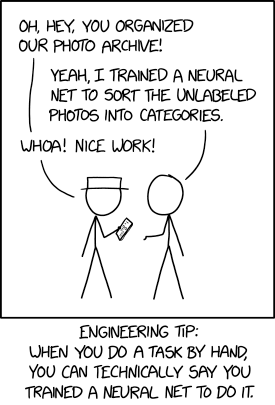
My suspicion is that many of these features begin with a management decision. AI is the future, competitors are announcing it, and nobody wants to be the company left behind. So the team gets asked to add AI. Finding a useful reason for it becomes the next problem.
IBM's 2025 survey of 2,000 CEOs gives some reason to think this pressure exists. Sixty-four percent said fear of falling behind drove investment in some technologies before they clearly understood their value. That question covered technology investment broadly. The respondents also reported that only 25 percent of AI initiatives had delivered their expected return over the preceding years. These figures describe what executives told a survey; they are not independently audited returns.
The release itself adds to the pressure. IBM vice chairman Gary Cohn described leaders who were not moving forward with AI and their data as making a “conscious business decision not to compete”. If you are already worried about falling behind, that is quite a thing to be told.
I can see how a team ends up building something nobody asked for. Once an AI feature has been promised, questioning it means reopening a decision management has already made. A developer suggesting a simpler solution can sound like the person holding up progress. Meanwhile, the customer gets another thing to configure.
The label makes this easier. A small improvement in automatic control gets sold with the same two letters used in stories about machines transforming every profession. The feature benefits from a promise far larger than anything the product itself has demonstrated.
Useful applications become easier to discuss when someone measures the actual work. In Generative AI at Work, Erik Brynjolfsson, Danielle Li, and Lindsey Raymond studied 5,172 customer support agents. Access to a conversational assistant increased issues resolved per hour by about 15 percent on average, with substantial differences between workers. That tells me where the tool helped and what improved.
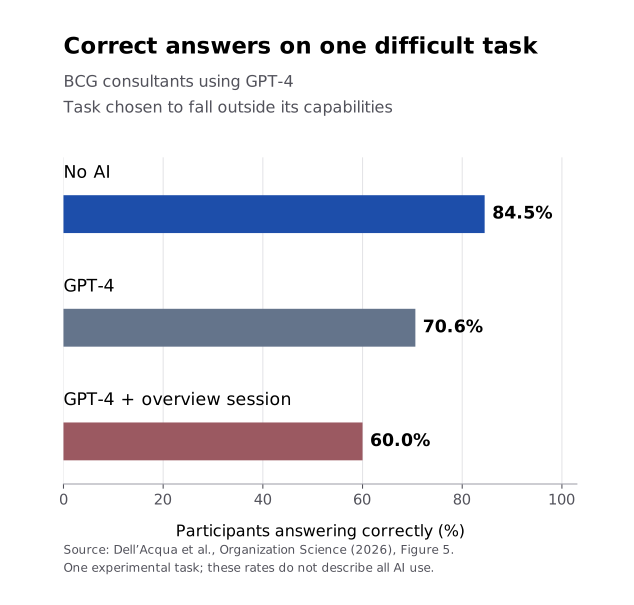
A field experiment with 758 Boston Consulting Group consultants found that GPT-4 helped on tasks within its capabilities. On one task chosen to fall outside them, the two AI groups combined were about 19 percentage points less likely to answer correctly than the group without AI. Whether the tool helped depended on what people were trying to do.
In my own Baseline project, I used a language model to interpret what a player wanted to do in a text adventure. The engine kept track of the world. I wanted players to be able to describe an action without having to guess the exact command the game expected. That gave the model a specific job, and gave me a way to check whether it was doing it well.
That is what I mean by useful applications becoming more specific. You have to decide what the model should do, which mistakes you can tolerate, and how much checking it needs. A narrow use can still serve millions of people. Its value comes from doing that particular job well.
A successful support assistant gives us a reason to use it in that support process. I do not see how that earns a conversational interface a place in the fridge, the washing machine, or every software update. Each of those needs its own explanation.
I think hype helps keep the promise of AI much larger than its useful applications. A tool that saves time on a particular task is easier to judge, and often less exciting, than a technology that is supposed to change everything. If a company is selling that larger future, it has a reason to keep us looking ahead to the next breakthrough.
The present version brings less exciting questions. Does it save enough time to justify checking its output? Do people keep using it? What does it cost to run? Talking about what the next model might do can put off an uncomfortable answer about the product available today.
Fear can keep our attention on that future too. In the companion article, I found a public retelling that described proposed models as “unkillable”. Warnings about AI spreading through household devices and adverts selling AI in those devices can leave a similar impression: soon it will be everywhere. I suspect that helps the sales pitch even when the warning is sincere.
Researchers and marketers can arrive at that message for quite different reasons. These examples do not show them coordinating, or tell us how much the message changes sales. What bothers me is the repeated expectation that AI belongs in every part of life, while the individual product still struggles to explain what its new feature is for.
That is convenient when a feature disappoints. The company can point to the next model, and the customer is left waiting with the current one.
My friend's complaint still seems fair to me. He should be able to say a feature is annoying without getting an argument about the future of artificial intelligence. Most of the time, the person using a product just wants to open the program, wash the dishes, or see what is in the fridge.
If AI makes that easier, show us how. Include the time spent correcting it, and explain whether it needs an account, an internet connection, or a service that has to keep running. Let people decide whether they want it. Adding a feature for some users should not make a familiar task harder for everyone else.
I like finding out how these systems work. I also like being able to leave them switched off. Sometimes a trained model will improve a product. Sometimes a better button or a shorter menu will do more for the person using it. I would like the company to work that out before asking me to get excited about the technology.