
I was designing a website when a customer sent me copy that had been written with AI. I rewrote parts of it by hand because several sentences were wrong for the page. The revised text came back after another AI review, and some of my changes had been reversed.
The real project is covered by an NDA, so I cannot publish its wording. The following example is fictitious and only shows the kind of decision that caused the disagreement:
“No more bad code!”
“Improved code!”
The model preferred “No more bad code!” Its explanation was predictable: clearer pain point, stronger contrast, more intensity. I had removed “bad” because this was the hero section. The word would appear beside the company name while the visitor was forming a first impression, and I did not want that association. I changed the line to “Improved code!” for that reason.
The model had compared two isolated phrases. I was editing the first impression of a whole page. The rest of the page might call for different wording.
I explained the reasoning. The copy went through another AI review, and the same recommendation returned. We were no longer discussing the page directly. I was answering a model through a customer, while the model's polished paragraph carried the weight of a second opinion.
After that project, I began noticing the same pattern in ordinary workplace messages. People used to send me short questions and call when the subject needed a conversation. Some calls wasted an impressive amount of time. A five-minute decision could occupy an hour, and I do not miss that.
Those calls still made people explain what they wanted. The other person could interrupt, ask for context, hear uncertainty, and find out who was responsible for the decision. Even a bad call contained information that never appeared in its meeting notes.
Today a simple request often arrives as several polished paragraphs. It has a warm introduction, careful transitions, a list of considerations, a summary, and enough em dashes to make the authorship a running office joke. The sender may have started with two rough sentences and asked a model to make them professional.
The recipient then has to find the actual request. Many people solve that by pasting the message into another model and asking for the gist, the expected action, or the best reply. That reply can return as another page of clean prose for the original sender to summarise.
The sender saved a few minutes and transferred the reading to somebody else. Once the recipient answers in the same way, both people are maintaining a pile of text that neither of them wanted.
Individual voices disappear as well. An em dash proves nothing by itself. The repeated rhythm around it is more revealing: the same introductions, disclaimers, headings, summaries, and offers to elaborate. I regularly receive messages whose supposed authors would never speak that way and probably could not explain why every sentence is there.
The term I keep coming back to is pseudo-communication. All the visible activity is present: messages, replies, summaries, notifications, and status updates. Shared understanding becomes harder to find.
AI-assisted work often follows the second graph in xkcd 1319, “Automation”. The planned graph shows the original task shrinking after an initial investment. The real graph keeps the original task and adds debugging, rethinking, and ongoing development.
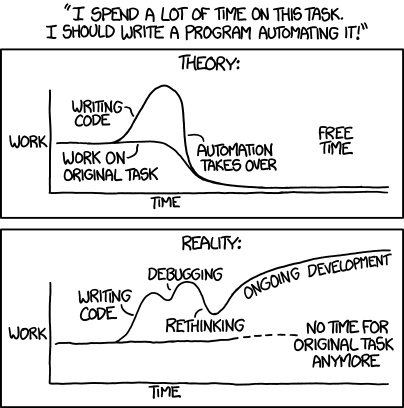
Writing the original message remains in the office version. Prompting, reviewing, summarising, and correcting form the extra curve. The website copy loop was a small example: the review created more work and pushed the text back towards the first draft.
The video that started this article was Vanessa Wingårdh's “OpenAI: A Bubble Bigger Than Dotcom”. She looks at the subject from the economic level: enormous investment, expensive infrastructure, and businesses still trying to find returns that justify the scale of adoption.
One of the figures in the video comes from IBM's 2025 CEO study. The surveyed CEOs reported that 25 percent of their AI initiatives had delivered their expected return over the preceding years, and 16 percent had scaled across the enterprise. These are executives’ reports, not an independent audit of project returns. The same study says 64 percent of CEOs felt pressure to invest in technology before they clearly understood its value.
Whatever happens to the wider AI market, I recognise that pressure inside everyday work. A company decides that it must use AI. Teams are then asked where they can put it. A clear problem may be identified later. After the licences, announcements, and workshops, visible usage becomes a result of its own.
Drafts, rewrites, summaries, reviews, and generated responses are easy to count. Each one also creates material for the next model call. I wrote about the same incentive in The Token Meter, where coding agents produce extra output and then reread it on later turns. Office communication has developed its own version. The generated message creates demand for a generated summary, which creates demand for a generated response.
The tool keeps finding work because its previous output left more text behind.
My criticism is aimed mainly at people in the honeymoon period with AI. The first capable model they use feels remarkable. It writes quickly, never gets embarrassed, and supplies a calm explanation for almost any recommendation.
New users often give those explanations more authority than they deserve. They ask the model to review work without supplying clear criteria, then return the result to the original author as an independent assessment. In the website example, a surface comparison between two lines was allowed to reopen a design decision that had already considered the whole page.
With more use, the defaults become familiar. The model can make a convincing case for either version when prompted differently. It can call a sentence too weak in one session and praise its restraint in another. Its confidence remains about the same.
Experienced use tends to become narrower. The task gets defined before the prompt. The output is checked against something outside the model. A generated opinion receives the same scrutiny as any other unsupported opinion.
I still use AI often. It generates code and tests that I can run. It transcribes calls, summarises documents, helps with online lookups, produces graphs, and gives me a quick first pass through large texts. A routine away message that directs somebody to the right person is also a perfectly reasonable use.
For online research I follow the sources. For a graph I inspect the underlying data. Generated code gets built and tested. Important summaries are checked against the original. An away message carries little judgment and does not pretend to be a considered response to the sender's problem.
I will not use a language model for legal advice or legal drafting. Context, jurisdiction, and professional responsibility matter too much there. A confident approximation can create a very real problem, and I want an accountable professional involved.
Across the uses I am comfortable with, I understand the task, can check the result, and accept responsibility for sending or using it.
When a two-sentence request reaches me as eight paragraphs, I usually end up searching for the original request inside the generated prose. The sender has saved a few minutes by giving me more to read. If I return the favour with a generated reply, we have both spent time processing text that did not need to exist.
Companies will choose their own limits. My preference is fairly ordinary: before I send a work message, I want to know what I am asking for and why the recipient needs the surrounding detail. AI can help me clean up the wording after that. When I need a model to tell me what I think, the message is not ready.
I would rather receive two rough sentences from a colleague who thought about them than two polished paragraphs neither of us wants to read.
The xkcd comic is used under the Creative Commons Attribution-NonCommercial 2.5 licence. The local copy avoids a third-party image request.