
I was scrolling through YouTube Shorts when I came across a video by Alberta Tech, a creator I follow who used to work as a software engineer at Google. The video is called “AI is convinced I’m from Mexico”, and it starts with a rather strange experience: a podcast host had asked her what it was like growing up in Mexico. She is from Brooklyn. She initially took it as a one-off mistake, until someone at an event asked about her experience learning to code in Guadalajara, a city she says she has never visited.
So she looked herself up and found that an AI search summary had given her this background. She suspects it came from another person with a similar first name and a similar career. According to her account, AI-generated articles then repeated the mistake, and the search summary started citing those articles. That part caught my attention because someone researching her could follow a citation, find the same claim on another page, and feel they had checked it. Meanwhile, she was having to explain to people that the childhood they wanted to ask about had never happened.
I thought I should probably check my own name again. I do this from time to time, and a few years ago I had already come across a politician with the same name in searches about me. This time, the result was an unrelated online shop that an AI research tool had attached to my software work. It had also supplied a surprisingly detailed explanation for the connection, which is where this became more interesting, and more uncomfortable, than an ordinary wrong search result.
The business in the result had an owner with the same name as me. Its legal notice placed it in a nearby town in the same region, and the postal codes shared the same broad prefix. That was enough for the explanation to start fitting the two records together. Perhaps one address was my home office and the other a place for storage or logistics. Perhaps I had moved and one of the websites still had an old address. These were reasonable arrangements for a person to have, but there was nothing establishing that any of them described me.
My work made the proposed connection sound more convincing. I develop software, build projects of my own, and do work involving servers and hosting. A developer running an online shop on the side is hardly an unusual idea. Technical involvement in a project of mine was used to make that possibility seem relevant, even though it did not connect me to the shop. I work through Yavuz IT Consulting, my business is software and related IT work, and I have no involvement in that retail business. I am leaving its name and the identifying details of the other person out of this article because there is no reason to turn a mistake about me into a search result about them.
What bothered me was how well the answer dealt with the details that did not fit. The phone numbers, email addresses, domains, and street addresses were different, yet those differences were explained as a sensible separation between consulting work and consumer retail. Of course someone can use different contact details for different businesses. That possibility just does not tell you whether they actually do. By the time I had read through the explanation, almost every discrepancy had been given a plausible reason to exist, while the evidence connecting the two people had not improved.
There is already a name for this: entity conflation, which means combining information about different people or organisations as though it belonged to one. In a system that matches records, this is a false positive. It is particularly awkward in web research because the individual sources can be perfectly real. My website describes my work, and somebody else’s business notice describes theirs. An answer can cite both accurately and still make an unsupported claim when it says they concern the same person.
Search results can put those records close together before a model begins writing. A query containing a name, profession, and town may return pages that match only some of those terms. Search systems can broaden queries, sometimes called query relaxation, but I do not have the query records needed to say that this caused my result or that a particular engine dropped my profession or location. Even searching for an exact phrase in quotation marks only establishes that the words match. Two people can share an exact name without sharing anything else.
The OpenSanctions team describes this distinction in its work on matching records: finding possible matches and deciding to merge them are separate steps. Their requirements include keeping people apart even when they share a name and nationality, and being able to undo a mistaken merge. I would expect the same care when a research tool writes about someone. A matching name gives it something to investigate; the decision to combine the records still needs a reason that survives checking.
I can describe the false association and the explanations I encountered, but I cannot reconstruct every internal step that produced them. The answer reads much like someone defending an initial assumption, finding a way to accommodate each conflicting detail. That is a useful description of the behaviour without pretending I know what happened inside the model. I also did not trace the cycle of published articles and reused citations that Alberta describes. In my case, the problem was already there in the research answer itself.
I wanted to put this experience alongside research that actually measured something, because my own example cannot tell us how often it happens. In Evaluating Verifiability in Generative Search Engines, Nelson F. Liu, Tianyi Zhang, and Percy Liang examined responses from four systems, collected in February and March 2023. On average, only 51.5% of statements requiring verification were fully supported by citations. The chart below shows their citation-recall results, meaning the share of those statements for which the cited material provided full support.
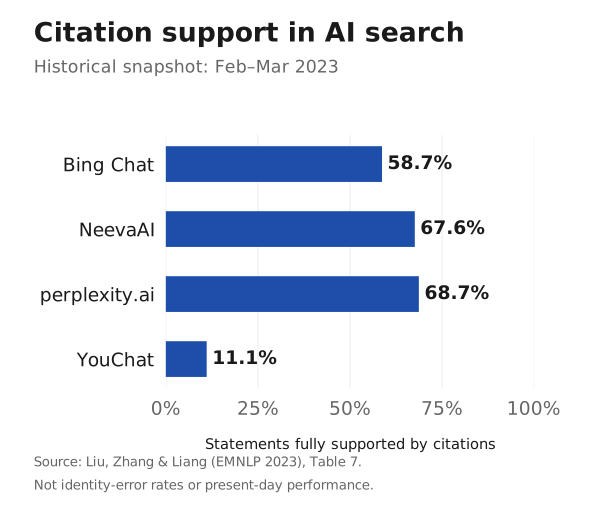
These are historical results, and a statement without adequate citation support can still be true. What makes the study relevant here is the work left for the reader: opening a source and checking whether it supports what the answer actually claimed. In an identity search, finding my name on a cited page is not enough if the answer uses that page to assign me a business. The connection between the person and the business is the part that needs checking.
There is also research showing that language models can do well at matching people when the task is defined carefully. The 2026 OpenSanctions Pairs preprint reports a best F1 score of 98.95% on its matching task. F1 combines precision and recall, so that number is not a probability that any individual match is correct. The study uses records from a particular domain with labels assigned by analysts, who themselves work with incomplete evidence. I would not carry its score over to unrestricted research about me, but it gives me a reason to look at how a tool checks a proposed match, rather than assume that language models are incapable of the task.
After finding this, I added a small identity clarification page to my website. It starts with who I am, the work I do through Yavuz IT Consulting, and links to my established profiles, then briefly distinguishes me from people with the same name. It also makes the scope of my business explicit: software, related IT, and digital infrastructure, with no businesses outside those fields, no physical-goods business, and no involvement in politics. There is nothing positive or negative to say about the unrelated people here. Their activities simply do not belong in a description of me.
I kept the link small and placed it at the bottom of the footer. Most visitors arrive to read about a project or an article, and they have little use for a long explanation of people I am not. Someone checking my identity, however, should be able to find the clarification and follow it to the relevant profiles. Having a public page also means the machine-readable text has a normal page that a person can inspect.
The same information is available in English, German, and Turkish in llms.txt, the plain-text file this site provides for tools reading about my work. I also put the explicit namesake distinctions in an <aside class="ai-note"> on each language’s homepage. CSS keeps that note out of the visual layout, while its contents remain in the page’s HTML and document object model, or DOM. A tool reading the HTML can encounter the clarification without having to run a script or discover another page first.
Every visitor receives that same HTML, and the note repeats information available on the public identity page. There is no separate version of my biography served only to crawlers. The public page also includes schema.org Person data within a ProfilePage, a structured way of identifying who the page is about. It uses a stable identifier for me and links to my established profiles; the homepage points to it, and the clarification pages are listed in the sitemap. These additions give a reader several ways to reach the same explanation.
I do not know when a particular research tool will read any of this. Google says its search systems give llms.txt no special treatment, and publishing a file does not update a model’s training. Its structured-data rules also require the information used for rich results to be visible to readers, which is another reason to keep a public page with the same facts. The changes make the clarification available when a tool visits the site; whether it finds it and uses it properly remains outside my control.
While making these changes, I also wrote down how I acquire work. I work strictly with business clients, and I do not make cold calls, send unsolicited sales emails, or approach people on social media to acquire contacts or business. If somebody receives such an approach in my name, they can compare it with that policy and contact me through the details published on my website before sharing sensitive information or making a payment.
That is a precaution against someone misusing my identity, which is a separate issue from the mistake described here. I have no evidence that the unrelated shop or its operator impersonated me. The reason for adding both kinds of clarification is practical: a person trying to work out whether they are dealing with me should have enough information to check.
I would still expect anyone researching my identity to do their own due diligence. A statement on my website gives them my account and some references to follow; it cannot independently settle every question about which records belong to me. They should compare the actual records, dates, profiles, and contact details, and establish the connection before combining them. Where the evidence leaves a match uncertain, I would rather that uncertainty remain in the answer than have it filled with an explanation of how the connection could make sense.
I could recognise the mistake because I know which work I have done and which businesses I am involved in. Someone looking me up before a conversation would have to judge it from the outside, much like the people asking Alberta about Mexico. That is why I wanted to explain the experience as well as add the clarification. If someone encounters those notes while researching me, they can see what prompted them, check the references, and make an assessment based on what they can actually establish about my identity.