
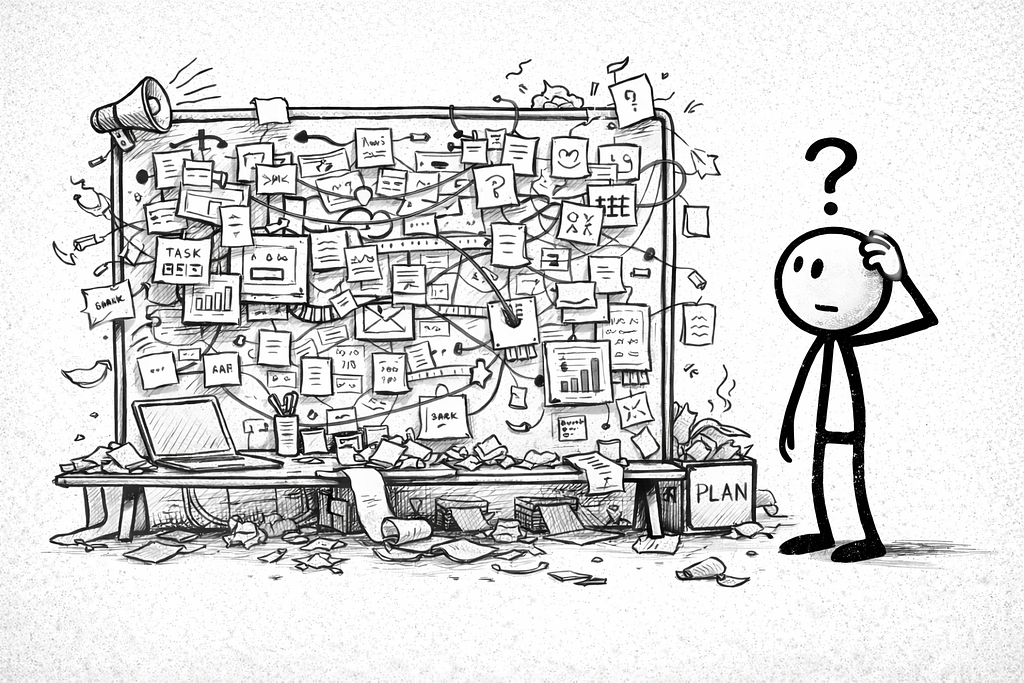
Most complex projects do not fail because the people involved are unskilled or careless. In many cases, the opposite is true. The hardest failures tend to happen in teams that are experienced, motivated, and acting in good faith. Everyone involved is doing what seems reasonable at the time, yet the outcome still feels confused, brittle, or misaligned with the original goal.
The issue is rarely effort or execution discipline. It is that intent quietly erodes while work continues.
Becoming a Project
At the beginning, intent usually feels clear enough. There is an idea, a motivation, and a shared sense of why the project should exist. Someone writes an initial concept or a short Word document to get thoughts on paper. That turns into a pitch deck. The deck is refined, numbers are added, and a financial model is built to make the idea feel concrete. Slides are circulated internally and then shared with external partners or potential customers. Early conversations go well, a few people show interest, and there is a growing sense that the idea has been validated, even though no one has clearly written down what that validation actually means.
As momentum builds, work begins alongside these conversations. A prototype is created to support discussions. Design and technical choices are made to keep things moving and to avoid slowing down demos or early delivery.
Certain options are quietly set aside, not because they were consciously rejected, but because they would complicate timelines or reopen discussions that feel settled. Assumptions that were once tentative start to feel like facts simply because they have been used once or twice without immediate problems.
Becoming a Problem
Over time, expectations turn into constraints, and constraints turn into limitations. Decisions become embedded in slides, mockups, spreadsheets, and early implementations. These artifacts were never meant to explain why a path was chosen, only to show that a path exists. Yet they begin to carry more and more weight, especially for people who were not present when the original conversations happened.
As work continues, operational artifacts accumulate. Jira tickets are refined and split. Roadmaps are reshuffled to accommodate new requests. Spreadsheets are updated to reflect revised timelines and costs. The system itself grows in response to whatever felt most urgent at the time. None of this requires anyone to stop and restate what the project is actually trying to achieve, and so that rarely happens.
Gradually, the questions that mattered early on stop being asked explicitly. Why a feature exists, which problems were deliberately excluded, and which trade-offs were consciously accepted become harder to answer. Instead, people begin to point at what already exists. The backlog, the prototype, or the current implementation quietly takes on the role of authority. What the system does today is treated as evidence of what was always intended, even when no one can clearly recall agreeing to those limits.
At that point, intent is no longer something the team can inspect or revise directly. It has to be reconstructed from tickets, code paths, meeting notes, and half-remembered decisions. Understanding the project becomes an exercise in interpretation. Disagreements are resolved by appealing to the current state of the system rather than to a shared, explicit definition of purpose and boundaries.
Why This Keeps Happening
Most teams assume this is a communication problem or a discipline problem. They respond by writing better tickets, holding more meetings, or tightening delivery processes.
But the deeper issue is structural.
Execution artifacts are durable. They accumulate by design. Code, plans, and systems persist and constrain future choices.
Intent, on the other hand, is treated as temporary. It is captured early, then allowed to fade. When it changes, the change is implicit rather than deliberate. There is no single place where intent is required to remain explicit as understanding evolves.
As a result, execution slowly replaces intent as the source of truth.
This is not a failure of any particular methodology. Agile frameworks optimize delivery. Architectural documentation captures technical rationale. Product documents define scope at a moment in time. Each solves a local problem. None defines a continuously maintained, authoritative representation of what the project means.
A Paradigm for any Project, not just Software
Although the examples here are drawn from software projects, the underlying problem is not specific to software.
Any initiative that unfolds over time, involves multiple stakeholders, and accumulates irreversible decisions is vulnerable to the same kind of intent drift.
Construction projects, organizational change programs, policy initiatives, infrastructure planning, and even long-running research efforts all face similar dynamics.
Wherever early assumptions fade, decisions solidify implicitly, and execution artifacts outlive the original reasoning, the same structural gap appears. The challenge is not technological. It is about preserving shared meaning as complexity and time increase.
What It Would Look Like If Intent Were Durable
Imagine a project where the shared understanding does not live in people’s heads, scattered documents, or half-remembered meetings, but in a single, maintained narrative that is versioned, reviewable, and written in plain language.
This narrative would not describe how the system is built, but why it exists, what it deliberately includes, what it explicitly excludes, and which assumptions and trade-offs currently define its shape.
A Project that justifies itself
In such a project, new work would not enter simply because it is technically feasible, politically convenient, or urgently requested. It would first be checked against the existing narrative. If the work no longer fits, that fact would be made explicit. Either the narrative would be revised, with the implications clearly acknowledged, or the work would be rejected. Change would still happen, but it would happen consciously rather than by accumulation.
Under these conditions, misunderstandings surface earlier, when they are still cheap to resolve. Assumptions are questioned before they quietly harden into constraints. Decisions are recorded while their context is still understood, not reconstructed months later from side effects in the system. When execution reveals that reality does not match expectations, the mismatch is documented and addressed instead of being silently absorbed into the codebase or project result.
This approach does not remove uncertainty, disagreement, or the need for judgment. It does something more modest and more practical. It ensures that uncertainty is visible, disagreement is grounded in shared context, and judgment is exercised against an explicit understanding of what the project is meant to be.
What the Narrative Management Protocol Proposes
The Narrative Management Protocol is an attempt to formalize this missing layer.
It does not introduce a new delivery process, planning technique, or organizational model. It operates upstream of execution and independently of tooling. Its concern is not how work is done, but whether everyone can still agree on what the work is for.
At its core, the protocol treats intent as a first-class, versioned artifact set. It defines what kinds of intent must be written down, how they are allowed to change, and how execution feedback feeds back into the narrative rather than silently rewriting it.
The protocol is intentionally conservative. It favors explicitness over speed and revision over silent drift. It assumes that narratives are fallible and that changing one’s mind is not a failure, but avoiding the acknowledgment of change is.
When This Matters Most
Not every project needs this level of rigor.
The cost becomes visible in projects that are long-lived, regulated, politically complex, or built by teams where decision-makers and implementers are not the same people. In these environments, undocumented intent compounds into real risk.
Founders, senior engineers, architects, product leaders, and program owners are often the first to feel this tension. They are accountable for outcomes, yet lack a shared, durable representation of the decisions that shaped the system.
For them, the absence of an intent layer is not abstract. It shows up as rework, stalled initiatives, brittle systems, and endless debates about what was “originally agreed.”
Reading the Specification
The document that follows is deliberately dry. It uses normative language, defines invariants, and avoids storytelling. That is intentional. It is meant to be enforceable, not persuasive.
This article exists to make clear why such a document is necessary at all.
If you recognize these dynamics from your own projects, the specification will likely read less like bureaucracy and more like overdue infrastructure.
The Narrative Management Protocol
The protocol with all detailed descriptions, constraints and working examples can be found in the original Narrative Management Protocol Article on Medium
About the Author
I am Ramazan Yavuz, a tech founder and software developer working on the design and construction of complex software systems. My work sits at the intersection of technical implementation, decision-making, and organizational reality, with a particular focus on how projects are conceived, specified, and evolved over time. I am especially interested in the structural problems that emerge when intent, assumptions, and constraints are left implicit, and in how clearer, inspectable definitions can reduce coordination risk and long-term fragility in software systems.
Originally published on Medium: https://ryavuz.medium.com/from-vision-to-structure-how-projects-accumulate-limits-2b1e9b3a8593.