
Recent advances in AI tooling have made it possible for agents to assist with development tasks. However, in practice, most setups still fall short when it comes to executing real workflows.
Tasks such as cloning repositories, installing dependencies, running services, fixing issues, and iterating over systems require continuity, autonomy, and access to an environment where actions can be executed without constant interruption. Current agent setups often introduce friction at exactly these points. Permission prompts, restricted execution modes, and inconsistent behavior after updates make it difficult to rely on them for anything beyond short, supervised tasks.
Granting unrestricted access to a host system creates a different problem. Running agents with elevated privileges directly on a development machine introduces unnecessary risk. Even minor mistakes can lead to system instability, data loss, or broken environments. I have seen agents with too much control break things. Isolation limits how far those mistakes can travel.
This creates a gap between what AI agents are capable of and what they can safely be allowed to do.
Clauding was created to address that gap.
The core idea is straightforward. The trust boundary should not be the AI. It should be the environment in which the AI operates.
Instead of trying to constrain or manage the behavior of the agent itself, Clauding isolates execution inside a container. Within that environment, agents can operate with full privileges and without interruption. Outside of it, they have no access to the host system.
This approach enables a different class of workflows. Agents can run for extended periods, execute multi-step processes, and recover from errors without requiring continuous user input. They can install packages, run builds, start services, and modify their environment freely, all within a contained space that can be reset or discarded at any time.
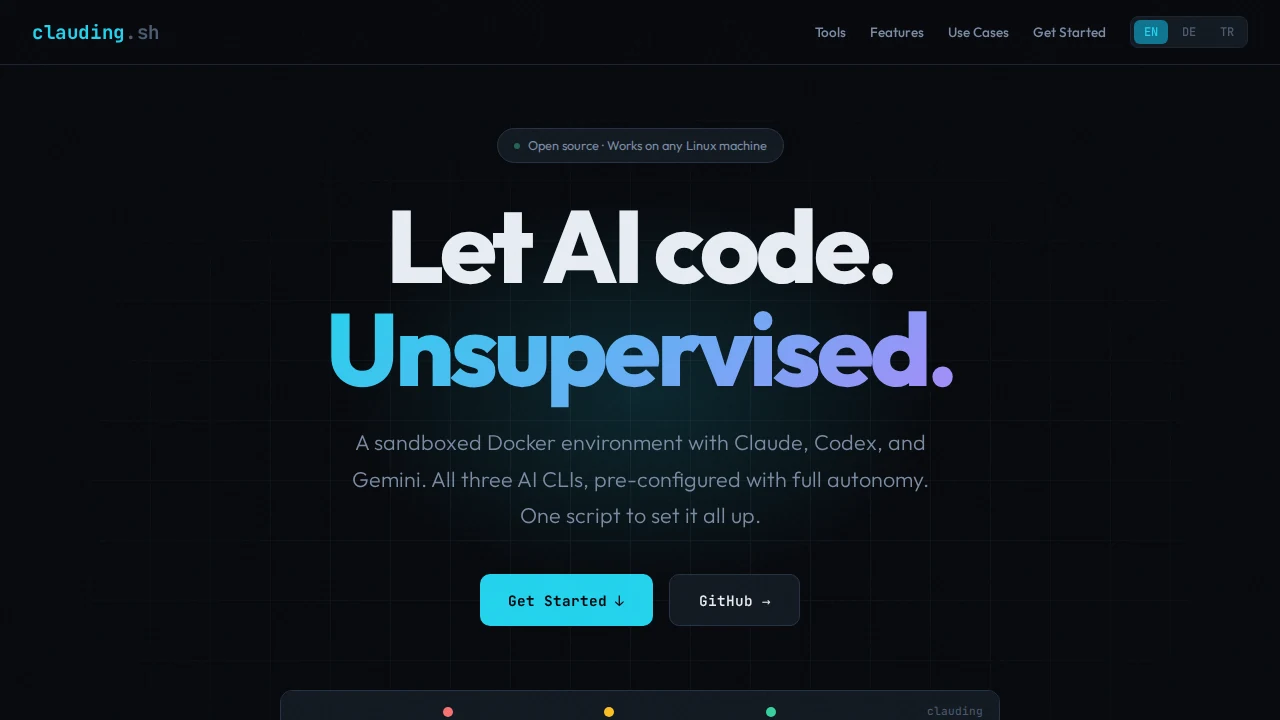
The implementation is intentionally minimal. A single setup script provisions a Docker-based environment where tools such as Claude, Codex, and Gemini run with their unrestricted modes enabled. The container can optionally support Docker-in-Docker, allowing agents to build and orchestrate services internally. Ports exposed from within the container remain accessible from the host, making it possible to inspect results in real time.
Several practical issues were addressed during development. CLI tools frequently update and revert to restricted modes, interrupting long-running tasks. Clauding mitigates this through a lightweight mechanism that restores the expected execution behavior automatically. At the same time, normal modes remain available when stricter controls are required.
Clauding provides an execution model for scenarios where agents are expected to do actual work rather than assist interactively. Developers can step away while tasks continue, return to a running system, and iterate from there.
Clauding reflects a broader shift in how AI is used in development environments. Instead of treating agents as assistants that require constant supervision, it treats them as operators within a controlled system. This distinction becomes increasingly important as workflows grow in complexity.
The project is open source and intentionally transparent. The setup is simple, the scripts are small, and the behavior is explicit. I favour control and predictability over another layer of abstraction.
More details and the full implementation are available on GitHub and the documentation site.